

Where the Old Highway Still Runs
Two hundred miles of US highway across the high desert, bypassed in 1962 and still there for the people who use it.
The old road lies in the high desert of the Great Basin, where the mountain ranges run north and south and the valleys go on farther than the eye wants to follow. It is a two-lane blacktop about two hundred miles long, and for most of that length it has no official reason to be a road. The interstate runs parallel to it, a few miles off, straight and new and in a hurry. The old road runs the way roads used to run before anyone was in a hurry: through every little drainage, around every shoulder of a hill, right up the main street of every town that chose to be on it.
The asphalt had a generation to settle. It heaved and cracked, and the cracks were patched, and the patches cracked, and then the patching stopped because no one had to drive that way anymore. The center line is worn down to a suggestion. The shoulders have slumped into the dust, and in the borrow pits along the right-of-way, old tires and bedsprings rust among the rabbitbrush. A fence line follows the road for miles, four strands of barbed wire on juniper posts. The posts lean the same way, pushed by the same decades of wind.
The wind is the road's main traffic. It comes off the mountains in the afternoon and crosses the valley without slowing, carrying a little dust, a little seed, the smell of sagebrush after rain. In the winter, snow comes down without drama and the road disappears. The county plows the two ends where people live, but the middle drifts shut and stays shut until spring, and nobody minds. That is part of what it means for a road to stop being a road: the seasons get it back.
The towns that held on
The towns the interstate left behind in 1962 are not ghost towns. Ghost towns are easy and photogenic. These are the opposite: places where people stayed, and staying took a certain stubbornness.

The houses are frame houses with tin roofs, painted when paint money could be spared. The yards are dirt, because a lawn is a lie in a country with this little water. There is a cafe that opens before dawn because the ranchers are up before dawn. There is a feed store, a mechanic's shop with a gravel lot, a county building where the flag goes up on weekdays. The people work on schedules older than the interstate: calving season, haying season, the gather in the fall, the thaw that lets the trucks in.
The school is small, with windows on two sides from the days when daylight was the cheapest light there was. In summer the children help with the hay. In winter the bus follows the old road where the plow has been, and where the plow has not been, the bus does not run. No one treats that as news.
The ones who stayed did not stay out of sentiment. They had land, water rights, a county job, a mother to look after, a tax bill they could afford because the land was cheap. The road leaving made the land cheaper and the quiet deeper. That was the trade, and they took it. A herd of cattle can be run here without hurry. The road does not care how long the work takes.
The day the traffic left
The interstate came through in the early 1960s, run across the flats on a straighter line than the old road had ever held. The grading crews came from somewhere else and camped in trailers and worked through the summers. The old road had followed the land, dipped through every wash, stopped at every town. The new road did not stop. It went over the country in a way that looked, from the air, like a line drawn with a rule.

When the interstate opened in 1962, the cars took the new line and did not come back. The old road was not damaged. It was not closed. It was simply excused from duty. A motel sat empty with its vacancy sign off. The gas station took down its sign. The cafe cut its hours, then cut its menu, then closed. The people who had served travelers went to work at the other end of the county, or left, or stayed and did something else.
The official handover took a while. For a few years the state still showed the old road on its maps, because it was still a highway at least on paper. Then the old number came off the signs, and the right-of-way passed to the county, and the county kept up the ends where people lived and let the middle go. Nobody tore up the road. It would have cost money, and it cost nothing to leave it lying there.
The years after that were not dramatic. There was no great migration and no sudden ruin. The towns just got smaller and slower. The people who remained had never depended on the road much; they depended on the water, the grass, the land, and those had not moved. The road had only ever been a convenience. When it stopped being convenient, it became something else: a long piece of the country, left down in the dirt.
What it is now
Now the road belongs to the people with local reasons. A rancher checks the spring pasture in a four-wheel-drive pickup and drives slower than the old speed limit, if a speed limit still applies. The mail carrier runs a route that has not changed since before the interstate. On Friday nights the high school kids drive the blacktop because there is nowhere else to go, and the road does not care.
In summer the heat comes off the dark surface and makes the air wobble. The pavement is rough enough to shake a loose bolt out of a fender, and two smooth tracks show where the drivers of the country have always put their wheels. Cattle are moved along the old road for the same reasons people used to move them on the highway: it is fenced, it is graded, it goes where the water goes, and no one is in a hurry to get past.

Something still replaces the cattleguards when they rot. Every few years, a county crew grades the gravel at the ends. The middle of the road is left alone, and left alone it does fine. The asphalt crumbles at the edges, the weeds take the shoulders, the frost heaves make the surface lurch in late winter, and then the spring comes and the road settles down for another year.
From a few places, the old road and the interstate climb the same gap in the mountains, and then the interstate's headlights are visible at night, a moving river of light, quick and steady. But most of the way, the old road keeps its own country. The number of lights in the towns has gone down. The number of stars has not. The quiet here is not an absence. It is a presence, deep as the valleys.
The old road never got a funeral. It got no museum, no historical marker, no place on any map that matters. It got something better. It got to be a road in the old sense again: a way from here to there, kept by nobody much, used by the people who need it. That is what the country does with things it is done with. It leaves them out in the weather, and the weather takes them back slowly, and if something still works, it works.
The road that stopped being a road turns out to have been a road all along.
From the shop
Picked for this story
Roper 1599 Western Blouse
$67.99
Leopard Denim Straight Leg Jeans
$27.67
Roper Nettie Crystal Cowgirl Boot in Pink
$137.49
Cowboys Club Cowboy & Horse Embroidered Patch Mesh Cap
$32.99
Stripe Cowl Neck Drop Shoulder Sweater
$26.65
Western Spade & Faux Turquoise Squash Blossom Earrings
$9.99
Colorblock Raglan Long Sleeve T-Shirt
$10.88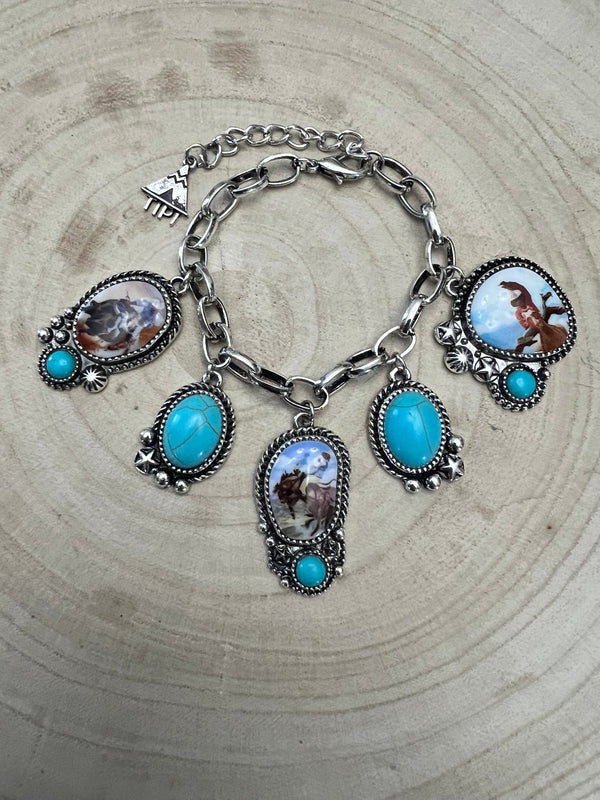
Western Rodeo Charm Bracelet with Faux Turquoise
$27.99Read next
More from On the Road
The Map Folded Wrong
A paper map in the truck door pocket, refolded wrong so many times the paper has set into the shape of where it has been.

The Canvas Work Jacket
It has crossed the West in every season, faded at the shoulders, marked by sparks, still stiff in the cold.

The High Desert Keeps Its Own Hours
In the high desert, light marks the hours and winter marks the year, and clocks are only a suggestion.